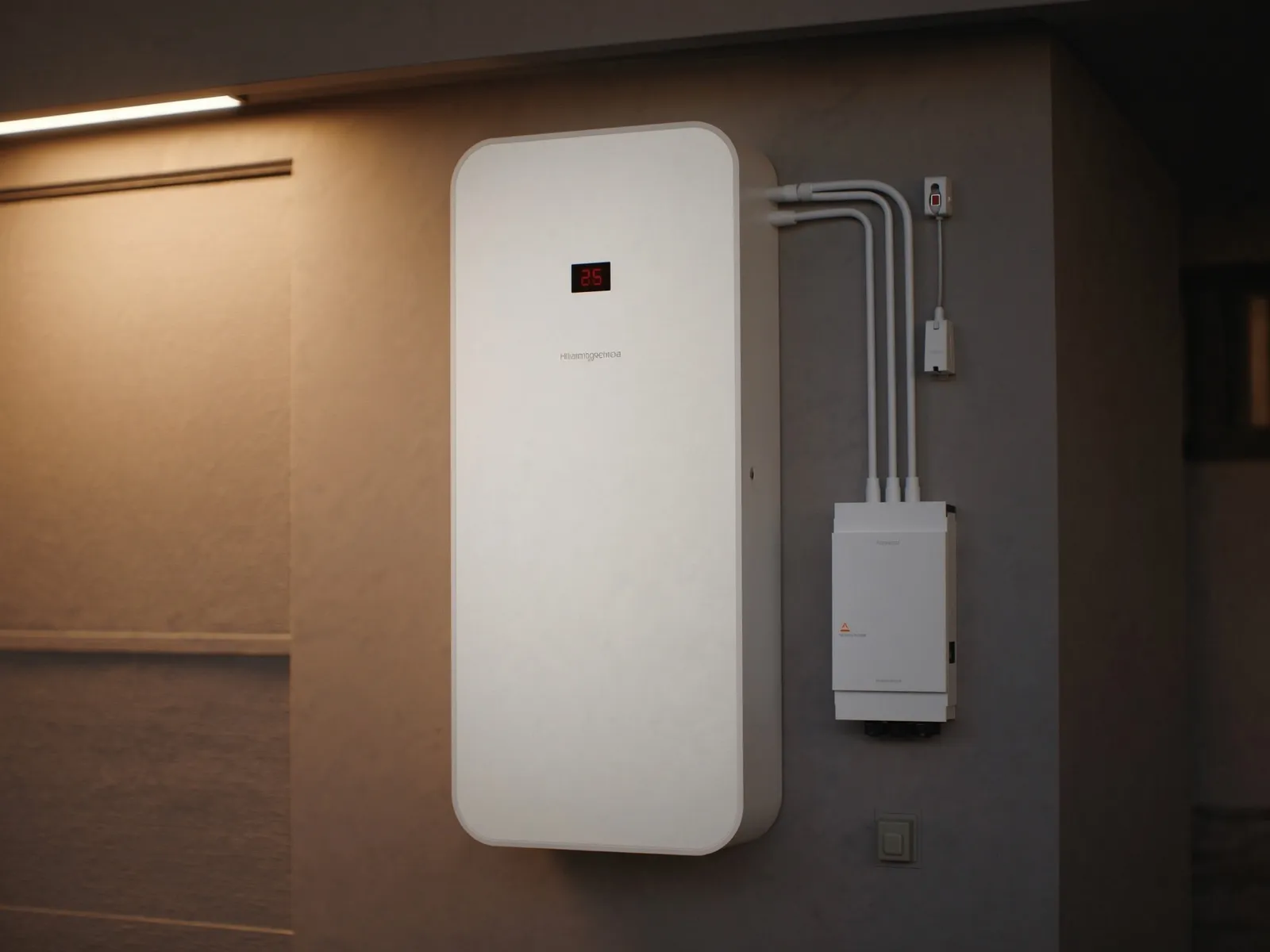
BYD is one of the biggest battery makers on the planet, and its Battery-Box Premium towers have
been a fixture in Australian homes for years. The appeal is simple: it's a well-built LFP battery
that works with a long list of hybrid inverters from other brands. That flexibility is its whole
story, for better and worse. It's a battery only, so the inverter you pair it with decides your
backup, your app and even your VPP options.
The verdict
Buy it if you already have (or want) a quality hybrid inverter such as a Fronius GEN24 Plus,
GoodWe or SMA, you like the idea of choosing your inverter and battery separately, or you want a
high-power HVM tower that can grow in small steps.
Skip it if you want one company responsible for everything, you want the strongest capacity
guarantee on paper (BYD promises 60% after 10 years, where several rivals promise 70%), or your
existing inverter isn't on BYD's list and you'd rather not replace it.
HVS vs HVM: the two BYD home batteries
The Battery-Box Premium range for homes comes in two flavours. Both are high-voltage towers of
stackable modules that plug together with no internal wiring, both use cobalt-free lithium iron
phosphate (LFP) cells, and both connect on the DC side of a compatible hybrid inverter.
| Spec | Battery-Box Premium HVS | Battery-Box Premium HVM |
|---|
| Module size | 2.56 kWh | 2.76 kWh |
| Usable per tower | 5.12 to 12.8 kWh (2 to 5 modules) | 8.28 to 22.08 kWh (3 to 8 modules) |
| Parallel towers | Up to 3, max 38.4 kWh | Up to 3, max 66.2 kWh |
| Continuous current | 25 A (50 A peak, 5 s) | 50 A (75 A peak, 5 s) |
| Rated power | Depends on tower size and inverter | 7.65 kW (8.3 kWh) to 20.45 kW (22.1 kWh) |
| Chemistry | LFP (cobalt-free) | LFP (cobalt-free) |
| Coupling | DC, third-party HV hybrids | DC, third-party HV hybrids |
| Backup | Via the inverter (extra hardware may be needed) | Via the inverter (extra hardware may be needed) |
| Rating | IP55, -10°C to 50°C | IP55, -10°C to 50°C |
| Round-trip efficiency | 96% or better | 96% or better |
| Warranty | 10 years, 60% retained or throughput | 10 years, 60% retained or throughput |
In plain English: the HVS is the compact one for modest storage, and the HVM is the
one most families end up with, because it goes bigger and delivers twice the current. A popular
HVM 13.8 (five modules) is rated at 12.8kW, which is more than enough to run a big house in the evening.
Modules weigh about 38kg each, so a full tower is heavy and needs a solid spot.
One rule to know if you plan to expand: you can't mix HVS and HVM towers in parallel, and every
parallel tower must have the same number of modules. Plan the growth path at the start.
Which inverters work with BYD
This is BYD's big selling point. Its official compatibility list covers more than a dozen inverter
brands. The ones you'll most often see quoted in Australia:
- Fronius: Primo GEN24 Plus (single phase, HVS 2 to 3 modules or HVM 4 to 7), Symo GEN24 Plus (three phase, HVS 2 to 5 or HVM 4 to 8) and Verto Plus.
- GoodWe: ET and BT (three phase), EH and BH (single phase) and EHB.
- SMA: Sunny Boy Storage, Sunny Tripower Smart Energy and Sunny Boy Smart Energy.
- Sungrow: the SH-RT three-phase range and the smaller single-phase SH-RS models (3kW to 6kW). The larger SH8.0RS and SH10RS aren't on the current list.
- Others: Kostal, Solis, Hoymiles, Solplanet and several more.
Notice the limits. A single-phase Fronius Primo GEN24 Plus, for example, only takes up to seven HVM
modules (about 19.3kWh) or three HVS modules. Your installer should check the module count against
the list and update the battery's firmware on install. Our
battery and inverter compatibility guide explains
why this matters.
The warranty, read properly
BYD's published Australian warranty for the HVS and HVM gives you:
- 10 years against defects in materials and workmanship.
- Performance: at least 60% of usable energy after 10 years, or until the battery has delivered a set amount of energy, whichever comes first. For an HVS 10.2 that's 30.82MWh, for an HVM 13.8 it's 42.69MWh and for an HVM 16.6 it's 51.23MWh. That's roughly 3,000 full cycles, or about eight years of one full cycle every single day. Most homes cycle less than that.
- A quirky start date. The warranty clock starts six months after the battery was made, unless you can show when it was delivered to your home, in which case it starts 30 days after delivery. Ask your installer to keep the delivery paperwork.
- It's transferable. Later owners are covered with proof of ownership, a plus if you sell.
- Temperature limits: it excludes damage from operating above 50°C or below -10°C, and charging slows below 5°C.
The 60% figure is the weak spot. Sungrow and AlphaESS both promise 70% over the same period. In
practice LFP batteries used at home tend to hold up well, but the paper promise is weaker. For more
on real-world lifespan, see how long solar batteries last.
Pros and cons
What we like
- Works with lots of inverters. Pick the hybrid you trust, or keep the one you've got if it's on the list.
- Genuinely modular. Plug-together modules with no internal wiring, expandable later.
- Strong power on the HVM. 50A continuous means bigger towers can run serious loads.
- LFP, cobalt-free cells from one of the world's largest battery makers.
- Transferable warranty, and an established local service partner (Alps Power).
What we don't
- 60% capacity guarantee, weaker on paper than several rivals.
- Two companies in the loop. When something goes wrong, the battery maker and the inverter maker can point at each other. A good installer earns their keep here.
- Backup depends on the inverter and sometimes needs extra hardware.
- No real homeowner app of its own. You monitor it through the inverter's app, and BYD's own app is mainly an installer tool.
- Needs a compatible hybrid. If your inverter isn't on the list, you're buying a new one too.
Real-world considerations
Backup and blackouts
Because backup lives in the inverter, it varies a lot. With a Fronius GEN24 Plus, the basic
PV Point gives you a single backup outlet of up to 3kW that comes on within seconds, while
Full Backup for the whole house (or selected circuits) needs a switch box and a Fronius smart
meter on top. GoodWe and SMA handle it their own way. Get your installer to write down which circuits
stay on and what it costs to add.
App and monitoring
You'll watch your BYD through the inverter's app, such as Fronius Solar.web, GoodWe's SEMS portal,
SMA's portal or Sungrow's iSolarCloud. That's fine, and often very good, but it means your experience
depends on the inverter you choose.
VPPs
VPP eligibility is really about the inverter. At the time of writing, AGL listed BYD HVS and HVM when
paired with Fronius, GoodWe or SMA inverters. In WA, Synergy's Supported Solutions List covers the
inverter rather than the battery, and the Fronius GEN24 Plus models are flagged as ready for VPP
activation. Check your exact pairing, and compare programs in our VPP guide.
Known issues and recalls
We found no Australian recall notices for the HVS or HVM while researching this review. The practical
issues we see raised are about setup: the right firmware, the right module count for the inverter and
a correctly configured backup. All installer-side, which is why who installs it matters.
What a BYD Battery-Box costs after the federal discount
Indicative, fully installed prices after the federal
Cheaper Home Batteries discount, including a compatible
hybrid inverter where one is needed. Your state incentive, if any, is a separate number and isn't included.
| Tower | Suits | Indicative installed (after federal discount) |
|---|
| HVS 10.2 (10.24 kWh) | Typical home, moderate evening use | From around $6,500 |
| HVS 12.8 / HVM 13.8 | Families with solid evening use | Around $6,500 to $10,000 |
| HVM 16.6 (16.56 kWh) | Bigger homes, more backup, EV plans | Around $8,000 to $12,000 |
| HVM 19.3 and up | Large homes | Quoted per job |
The biggest swing is the inverter. If you already have a compatible hybrid, you're mostly paying for
the tower and install, which puts you at the lower end. Needing a new hybrid pushes you up. Size above
14kWh matters too, because the federal discount pays the full rate on the first 14kWh, 60% of it from
14 to 28kWh and 15% from 28 to 50kWh. For wider context, see
how much a solar battery costs and
what size battery you need, or run your own numbers through the
savings calculator.
Rebates: federal and state, kept separate
Eligible BYD towers qualify for the federal discount, applied by your installer on the invoice. Your
state may add its own incentive, such as VPP connection payments in NSW or a state battery rebate in
WA, where the inverter has to be on the approved list. We quote the federal discount and any state
incentive as two separate numbers, never merged. See what applies where you live on our
solar battery rebate pages.
How BYD compares
- vs Sungrow: similar LFP modular towers and similar money. Sungrow gives you one-brand simplicity and a 70% guarantee but locks you to Sungrow inverters. BYD gives you inverter choice. See our Sungrow review.
- vs GoodWe Lynx: if you're buying a GoodWe hybrid anyway, GoodWe's own Lynx batteries are the natural alternative to a BYD tower on the same inverter. Compare quotes. Read our GoodWe Lynx review.
- vs Tesla Powerwall 3: an all-in-one with a built-in solar inverter and whole-home backup, simpler to own but usually dearer, and a fixed 13.5kWh per unit.
- vs AlphaESS: an all-in-one system with an AC-coupled retrofit model. Our AlphaESS SMILE review covers it.
More on the brand is on our BYD battery page. Other reviews:
Sigenergy SigenStor and
FoxESS.
The bottom line
The BYD Battery-Box is a proven, flexible battery that shines when it's paired with a good hybrid
inverter, especially if you already own one that's on BYD's list. The HVM is the pick for most
families. Go in knowing the capacity guarantee is weaker on paper than some rivals, and that your
backup, app and VPP options all come from the inverter. Get those three things spelled out in the
quote and it's a very sound buy.